Make this page easier to read
Your choices are saved on this device.
Sony's own history says Beta and VHS tapes could not play in each other's machines. A two-hour VHS cassette and the growing rental market helped determine which system households encountered.
Buying a video recorder could feel like choosing a future library. The family wanted to record a program and borrow films, but a tape from one system would not fit the other's machine. Once relatives and a local rental shop favored a format, the decision reached beyond the living room. It shaped which cases a child could bring home from a shelf.
Why were the formats incompatible?
Sony's company history of the format contest dates its first consumer Betamax model to 1975 and describes JVC's competing VHS announcement in 1976. The company states plainly that the cassette types were not compatible. At launch, VHS offered a two-hour recording capacity, while Sony emphasized the smaller Beta cassette and picture quality. Later models improved on both sides, so a single early specification should not be treated as true for every machine ever sold.
 Illustration created for WistMem; not an archival photograph.
The same Sony history says VHS makers supplied equipment to major manufacturers in the United States and Europe and had a large catalog of recorded titles. By 1988 Sony decided to sell VHS-compatible products too. That timeline makes the familiar phrase “Beta lost” more precise: households changed at different times, and Sony did not abandon its existing customers overnight.
What was the choice like for a family?
Ask which format their first recorder took, whether they mainly taped television or rented films, and what the local shop actually stocked. A manual, a blank cassette, or a rental receipt can identify the machine more reliably than a memory of its color. A parent may recall the price; a child may recall being told to put a borrowed tape back in its case.
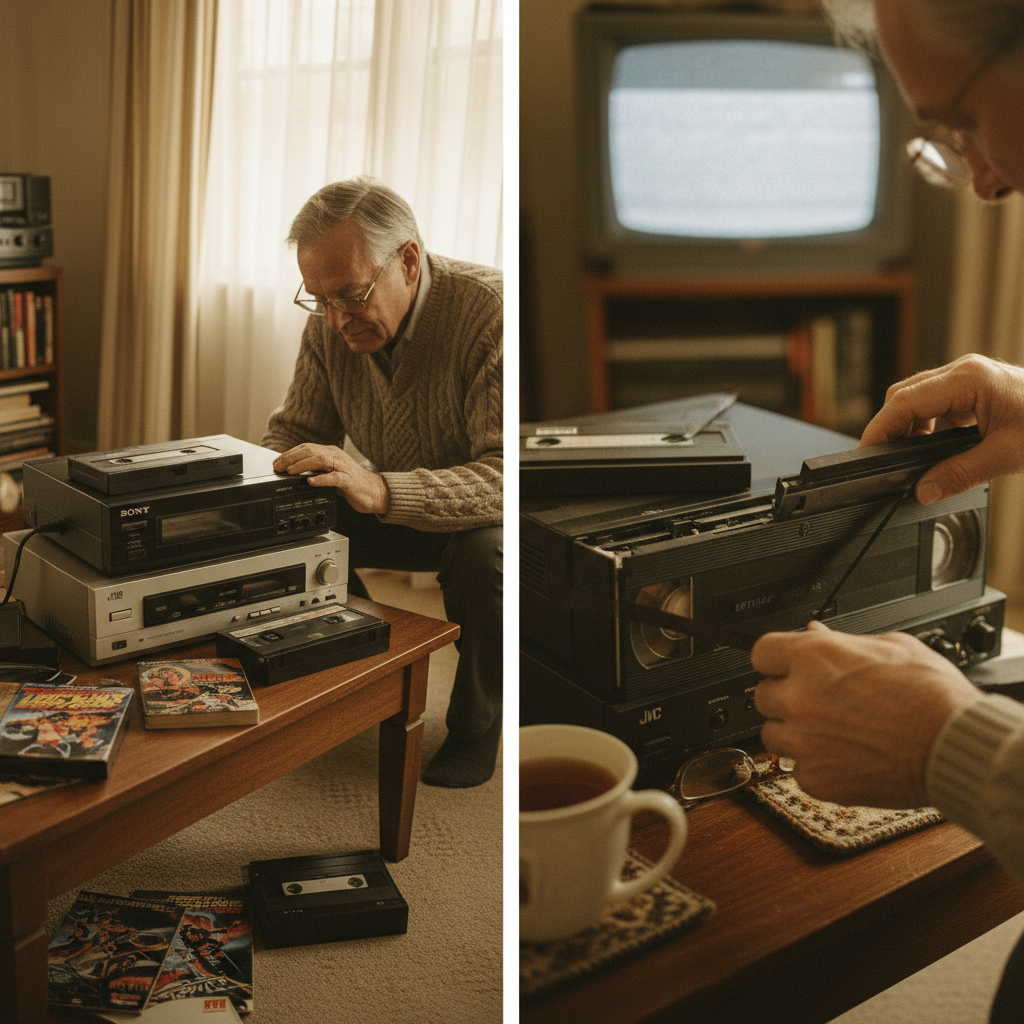 Illustration created for WistMem; not an archival photograph.
The most revealing detail may be a film the family could not rent until they changed machines. Keep the account with the tape label or photograph of the recorder. For the ritual that grew around rental shelves after this contest, read Blockbuster Video Friday Night.
What does it bring back for you?
Ask someone who remembers, or begin with your own version. A few words can be enough.
What object changed how you spent an ordinary day?
Then ask: How did you learn to use it, and what could it not do?
Find more conversation starters Choose what feels comfortable. Ask before recording or sharing someone’s words.Relive the Memory
Find a little of the story.
Something here bring back a memory? Take a look at what you can find today.
Searching for: vintage betamax vhs war
Vintage & collectible finds
Look for older objects and collectibles connected to this memory.
Search eBay (opens in a new tab)Related finds on Amazon
Explore items related to the same topic, from familiar styles to things made today.
Search Amazon (opens in a new tab)These links open search results. Items, prices, and availability vary.
Affiliate links. We may earn a commission at no extra cost to you.
As an Amazon Associate I earn from qualifying purchases. As an eBay Partner, WistMem may earn from qualifying purchases.
Does this bring back memories?
Share this story with someone who would remember.